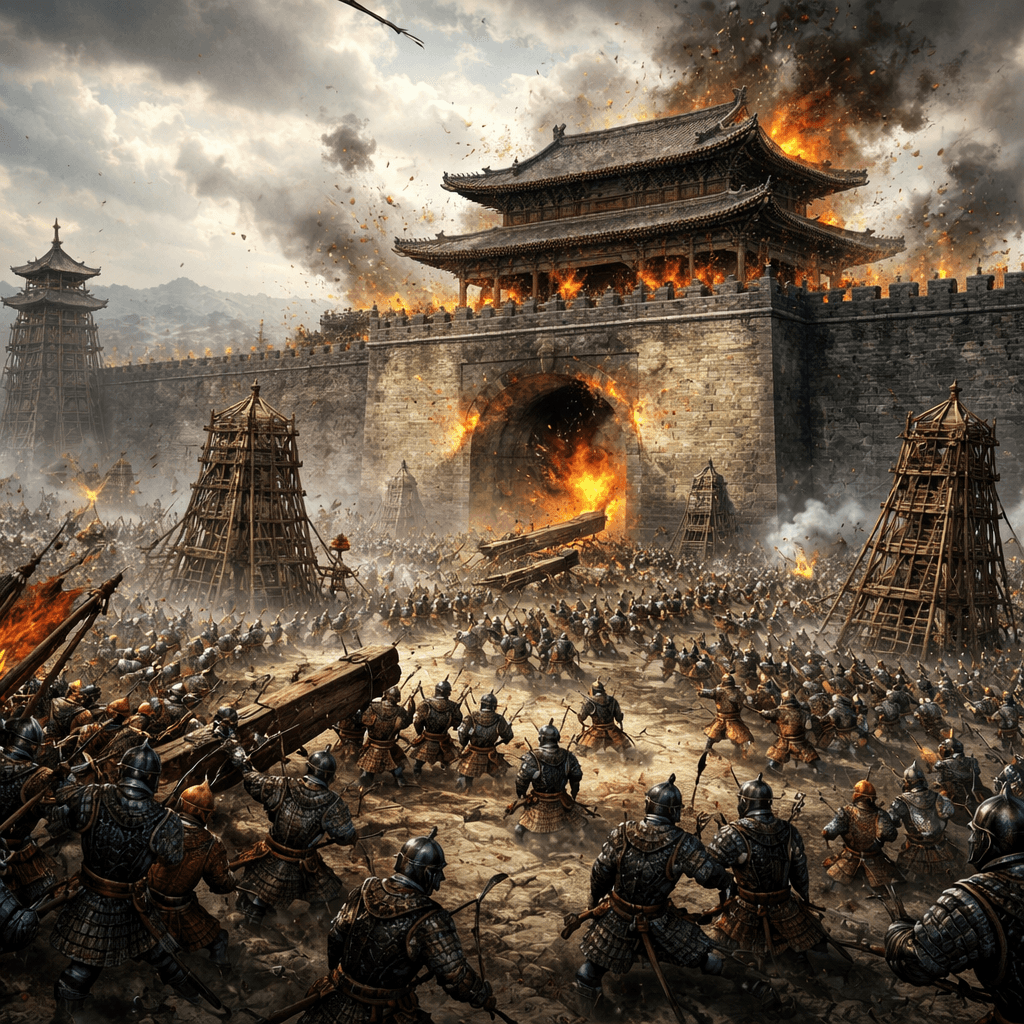
The Third Battle of Nanjing (1864) was the climactic finale of the Taiping Rebellion. After a two-year encirclement, the Qing Dynasty’s Xiang Army, led by Zeng Guoquan, breached the walls of the Taiping "Heavenly Capital" using massive underground explosives. The fall of the city ended the Taiping Heavenly Kingdom but resulted in a horrific massacre. Qing forces engaged in three days of systematic slaughter and looting, while thousands of T..
|
|
The Battle of Amoy (1660) was a major naval and land engagement during the Transition from Ming to Qing. Following a failed attempt to take Nanjing, Koxinga (Zheng Chenggong) retreated to Xiamen (Amoy) to regroup. The Qing Dynasty launched a massive two-pronged amphibious assault with tens of thousands of troops to eliminate the Ming loyalist stronghold. Despite being outnumbered, Koxinga’s superior naval tactics and "Iron Armored" heavy in..
|
|
The Defense of Hongdu (1363) was a legendary siege during the Red Turban Rebellion. Zhu Yuanzhang’s nephew, Zhu Wenzheng, defended the city with just 20,000 to 40,000 troops against a massive 600,000-man force led by rival warlord Chen Youliang. For 85 days, the vastly outnumbered garrison repelled non-stop naval and land assaults, repairing the city walls even as they were being breached. This incredible feat of endurance exhausted Chen’s ..
|
|
The Siege of Diaoyucheng (1259) was a miraculous defense during the Mongol conquest of the Song Dynasty. Located on a mountain in modern-day Chongqing, the "Fortress of Fishing Fish" held out against a massive Mongol army led by Möngke Khan. For five months, the Song defenders utilized the city's unique mountain geography and intricate water systems to repel Mongol assaults. The siege reached a dramatic conclusion when Möngke Khan—the Great..
|
|
The Jingkang Incident (1127) was the catastrophic collapse of the Northern Song Dynasty. Following a prolonged siege of the capital, Kaifeng, the invading Jurchen Jin Dynasty breached the city walls and captured the Emperor Qinzong and his father, Retired Emperor Huizong. The event resulted in the wholesale looting of the city and the forced march of the entire imperial court—thousands of nobles, artisans, and women—into captivity in the no..
|
|
The Siege of Suiyang (757 CE) was a brutal turning point in the An Lushan Rebellion. Tang General Zhang Xun defended the strategic gateway to southern China with 7,000 men against 150,000 rebels. After ten months, the city ran out of food, leading the garrison to resort to horrific mass cannibalism to maintain their post. Though the city eventually fell and the survivors were executed, the delay allowed the Tang Dynasty to regroup and ultim..
|
|
The Battle of Zhongli (507 AD) was a catastrophic defeat for the Northern Wei dynasty and a major strategic victory for the Southern Liang dynasty during China's Northern and Southern dynasties period. The conflict centered on the strategic fortress of Zhongli, which was besieged by a massive Northern Wei army led by Yuan Ying and Yang Dayan. Despite being outnumbered, the Liang defenders held out until a relief force arrived under General ..
|
|
The Battle of Hefei (208–209 CE) was a major confrontation between Sun Quan and the forces of Cao Cao during the Three Kingdoms period. Following the victory at Red Cliffs, Sun Quan attempted to seize the strategic city of Hefei to open a gateway into the Central Plains. Despite leading a massive army and besieging the city for over 100 days, Sun Quan was unable to breach the defenses held by Cao Cao’s general, Liu Fu. The siege was eventua..
|